Your Tipster Is Winning. You’re Losing. Here’s Why.
You found a tipster with a proven 17% ROI.
You follow every tip.
And yet, your account tells a different story.
They are winning.
You are not.
This isn’t bad luck.
It’s not variance.
It’s not timing.
It’s a structural drain happening on every single bet.
It has a name:
The Execution Gap.
The Illusion You’re Being Sold: Ghost Profit
Every tipster dashboard shows the same thing:
Profit. ROI. Streaks. Growth.
But there is a hidden assumption behind all of it:
You got the same odds they did.
You didn’t.
That profit is Ghost Profit — it only exists in a world where:
- odds never move
- markets don’t react
- thousands of people aren’t trying to get the same price
In reality, the moment a tip is published, the price starts to decay.
And you pay for that decay on every single bet.
The Real Problem: You Are Betting at a Different Game
A tipster is not selling picks.
They are effectively selling a price-sensitive financial instrument.
And you are often buying it late.
That delay creates a gap:
Tipster ROI = theoretical execution
Your ROI = degraded execution
That difference is the Execution Gap.
And over time, it compounds into something much more serious than “slightly lower profit”.
It changes whether you win at all.
The Hidden Mechanism: Price Slippage
The Execution Gap is just one thing:
The difference between advised odds and the odds you actually take.
Even small changes matter more than most people realise.
Because ROI is not linear against price drift.
It compounds.
A small reduction in price does not slightly reduce profit.
It reshapes the entire distribution of outcomes.
The Cliff Edge: Where Profit Stops Existing
There is a hard boundary in the system:
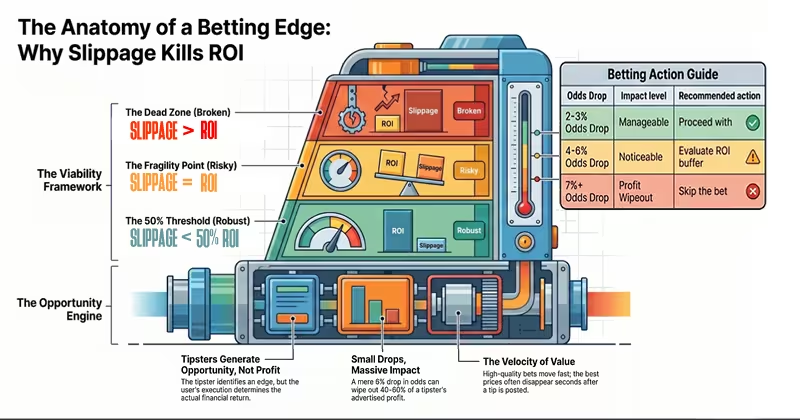
Your allowable price slippage is roughly equal to the tipster’s ROI.
Once you cross that boundary:
- you are no longer capturing edge
- you are no longer “profiting less”
- you are operating without expectation
This is the Death Zone.
And it is binary in effect, even if it doesn’t feel binary in practice.
The Execution Zones
Instead of rules of thumb, the system breaks into three states:
🟢 Green Zone — Edge intact
You are close enough to advised odds that the strategy works as intended.
🟠 Amber Zone — Edge eroding
You still win, but a large portion of expected profit is gone.
🔴 Red Zone (Death Zone) — Edge gone
You are no longer betting with an advantage.
You are participating without compensation.
The reality looks like this:
| Tipster ROI | Amber Zone (~50% profit lost) | Death Zone (~100% profit lost) |
|---|---|---|
| 5% | ~2.5% slippage | ~5% slippage |
| 10% | ~5% slippage | ~10% slippage |
| 15% | ~7.5% slippage | ~15% slippage |
| 20% | ~10% slippage | ~20% slippage |
Why Most People Never Notice This
Because the tipster still looks like it works.
You still see:
- winners
- streaks
- positive months
- screenshots of profit
But your version of that same system behaves differently:
- good months feel flat
- flat months feel like losses
- losses feel catastrophic
Not because the system changed.
Because your entry price did.
The Core Insight Most Bettors Miss
A tipster should not be evaluated just on their published ROI.
They must be evaluated by something simpler:
Can you consistently get close to the same odds they publish?
If not, you are not following their system.
You are following a degraded version of it.
Everything else is noise.
Real-World Effect: Small Drift, Large Damage
Simulations of realistic execution show a consistent pattern:
A ~7% drop in price can:
- cut total annual profit by ~30–50%
- significantly increase drawdown depth
- turn break-even months into losing months
And at higher odds, the effect accelerates.
Because you are not just losing value per bet.
You are changing the shape of variance itself.
Why “Universal Rules” Fail
Rules like:
- “avoid anything worse than 7% drift”
- “only bet within X minutes”
fail because they assume all tipsters are equal.
They are not.
Each ROI level creates a different tolerance curve:
- Low ROI systems collapse quickly
- High ROI systems tolerate more decay
- But all of them eventually hit a cliff
There is no universal threshold.
Only relative ones.
The Decision Rule That Actually Works
Forget heuristics.
There are only three comparisons that matter:
- Estimate tipster ROI
- Estimate your real slippage
- Compare them directly
Then:
- Slippage < ~50% of ROI → system works
- Slippage ≈ ROI → system is fragile
- Slippage > ROI → system is broken
That is the entire decision framework.
Everything else is decoration.
The 15-Minute Reality Check
If you want to see this in real time, do this:
Check the odds:
- at time of tip
- 15 minutes later
If the price consistently moves into worse territory quickly, then:
- you are not late occasionally
- you are structurally late
No ROI figure survives structural lateness.
The Final Truth
A tipster does not generate your profit.
They generate an opportunity.
But opportunity only becomes profit if you can actually access it.
And that access is the entire system.
Not the picks.
Not the ROI.
Not the streak.
The entry price.
Bottom Line
If you take only one idea from this:
Tipster profit is theoretical. Execution is everything.
If you are consistently late to the price, you are not following a winning system.
You are following a system where the edge already left before you arrived.
And over time, that difference compounds into the only thing that actually matters:
your bankroll.
The Law Of The Gap
Slippage > ROI → No Bet